Why You Have Eastern Subterranean Termites and the House Next Door Might Not
Georgetown sits on slab-on-grade construction over expansive clay, and that clay is exactly the kind of ground a subterranean colony can work through without ever coming up for air. The termites live in the soil, not in the wood, and they only need a way up through or around the slab to reach the framing above.
Neighborhoods built over the last couple decades, from Teravista out to Wolf Ranch and Cimarron Hills, sit on the same clay as the older streets around Old Town, and a slab is a slab regardless of the build date. Any wood-to-soil contact at a porch step, a deck post, or a stack of firewood against the house gives the colony a shortcut in that skips the slab edge entirely.
Late summer brings the fall field cricket flood, and Georgetown's lit storefronts along Austin Avenue and the pump islands near I-35 draw them by the thousands once the weather turns. A porch light left burning past dark pulls in more crickets than a whole can of spray keeps out. Swapping a white bulb for a warmer one, or just shutting outdoor lights off earlier, thins the swarm more than most homeowners expect.
Quick Identification
- Mud tubes on pier or slab
- Pencil-width, running up the foundation
- Discarded wings on windowsills
- Left after a daylight swarm
- Swarmer body color and size
- Dark brown, roughly a third-inch long
- Trim that sounds hollow
- Tap-tested along baseboards and door frames
- Swarm timing after rain
- Daylight, February through May locally
- Local Pest Knowledge
- Swarms after warm rain, February through May, earliest near Old Town and San Gabriel Park, later as spring cools
- Annual Contract
- an estimated $449–$1400
Call Now for a Free Inspection
Flying ants after rain. Winged termites and winged ants get mixed up on a windowsill after a swarm. A termite has four wings of equal length and a thick waist with no pinch; an ant's wings are unequal and its waist narrows sharply. Termite antennae run straight, an ant's bend at an angle. If the wings left behind are all one size, treat it as a termite entry point until a licensed pro confirms it.
What a Professional Eastern Subterranean Termites Job Looks Like
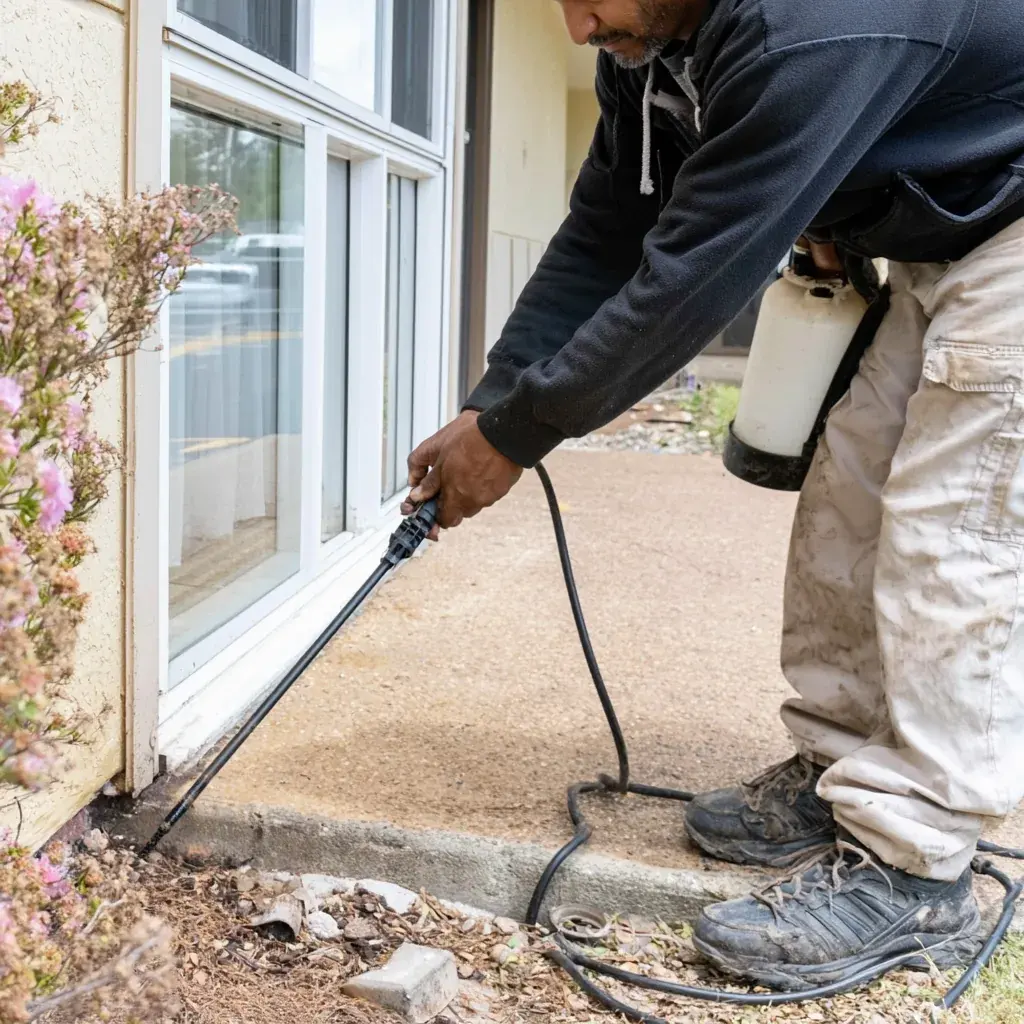
Control starts with an inspection that traces where the mud tubes actually run, not just where they are easiest to see, since the visible tube on a pier or slab edge is rarely the only entry point into the structure. The licensed pros we connect you with map the foundation, the porch attachments, and any exterior wood-to-soil contact before deciding where to treat.
From there the usual approach is a liquid termiticide applied around and under the slab perimeter, or a bait system placed in the soil where activity is confirmed, sometimes both on the same house. Either way it is a job for a technician licensed in the termite category, since the goal is to cut the colony off from the structure, not just to spray where the wings turned up.
A scorpion under the bathroom door in July gets a same-day call. A rat scratching in the attic over Wolf Ranch or Teravista in January gets put off for a week, then two. Both are worth acting on quickly, just for different reasons — one is a safety question for anyone with kids or pets in the house, the other is a structural one that gets more expensive the longer a roof line stays open.
Licensed help, no guesswork, no pressure
| Georgetown Pest Pressure Explained |
Scorpion Calls Answered Fast |
|---|
| Fall crickets swarming lights near Wolf Ranch and I-35 | Scorpions Under Doors |
| Why the west side of I-35 sees more scorpion calls | Fire Ant Mound Alerts |
| Scorpion and roof rat calls from Sun City to Old Town | Roof Rats Enter Above the Foundation |
What Store-Bought Products Do to Eastern Subterranean Termites
A homeowner can knock down a mud tube or clear firewood and mulch off the foundation, and both are worth doing. Neither one kills a colony living in the soil under the slab, and store-bought sprays on a mud tube just push the workers to rebuild a few inches over. Once tubes, hollow trim, or swarmers indoors are confirmed, this stops being a project for around-the-house products.
Eastern Subterranean Termites and Safety, in Plain Terms
Eastern subterranean termites do not bite people, sting, or spread disease, and they are not a health hazard to anyone living in the house. The cost is to the structure, not to the occupants, and it runs quietly for a long time before anyone notices, which is why the early signs matter more than the damage itself.
Talk to a Georgetown Pro
A scorpion under the door or a fire ant mound that showed up overnight after rain is not something to sit on in Georgetown. The licensed pros we connect you with know that the west side of I-35, from Sun City down through Cimarron Hills and Water Oak, is limestone ground where these things move differently than they do east of the highway. Call and describe what you're seeing — a phone call costs nothing and gets you talking to someone who can actually place the problem.Scorpion visits usually come with an entry point already at fault — a slab crack, a loose weep screen, a gap around a laundry line. Fixing that spot is often folded into the same visit rather than billed as extra, since it's a few minutes of caulk and screen versus a repeat call in July. Roof rat exclusion works the same way: the estimate covers sealing the fascia gap or gable vent that let them into the attic in the first place, not just clearing what's already up there. pricing guide, and the service that handles this is Termite Inspection.